New Jersey Trends in Substance Abuse
New Jersey Trends in Substance Abuse
Nancy N. Delogu, Esq.
No matter how hard we work at substance abuse prevention, education, and treatment, the nature of addiction seems to ensure that it will be a long time before the United States can conclude that it has eliminated the scourge, much as it once eliminated polio. Nevertheless, the elimination of substance abuse is a worthy goal, and recent reports issued by the U.S. Substance Abuse and Mental Health Services Administration (SAMHSA) on substance abuse trends by state demonstrate some regions experience much lower rates of substance abuse than others. How does New Jersey measure up? And do the numbers suggest strategies to help improve those numbers?
SAMHSA has been conducting a national survey on substance abuse since 1971 through the National Survey on Drug Use and Health (formerly known as the “National Household Survey on Drug Abuse).
The Survey results can be disconcerting. For example, the researchers found that on a national level, in 2009 an estimated 47 percent of the U.S. population aged 12 or over had used an illicit drug in their lifetime, and 15 percent reported using an illegal drug in the last year. Marijuana was the most commonly abused drug, with “nonmedical use of psychotherapeutics” the second most common type of substance abuse. Past month use, which provides a more current snapshot of drug abuse, was estimated at 8.7%. (The numbers go up, unsurprisingly, when the researchers focus on those aged 18 and above.)
Data collected from more than 200,000 people between 2006 and 2008 show that substance use disorders vary extensively among regions within each State and throughout the country, however. So how does New Jersey measure up against the national numbers?
According to the “Substance Abuse in Substate Regions” report issued in August, 2010, which breaks down data gathered between 2006 and 2008, past year illicit drug use disorders ranged from 1.5 percent in 2 substate regions in southern Pennsylvania to 6.7 percent in a region in the District of Columbia.
As for current use, the data suggests that the Northeast (which includes New Jersey) states reported an 8.64% rate of current substance abuse, second only to the Western region, which reported a 8.95% of abuse. New Jersey’s estimated rate of past-month substance abuse for 2007 was 6.48%, however, down from 7.44% the year before, and well below that of neighboring states New York (9.08%) and Delaware, (8.55%) and even better than Pennsylvania (6.98%). In fact, New Jersey and Pennsylvania had the lowest rate of substance abuse of any Eastern states, registering substance abuse levels more commonly seen in the rural middle of the country.
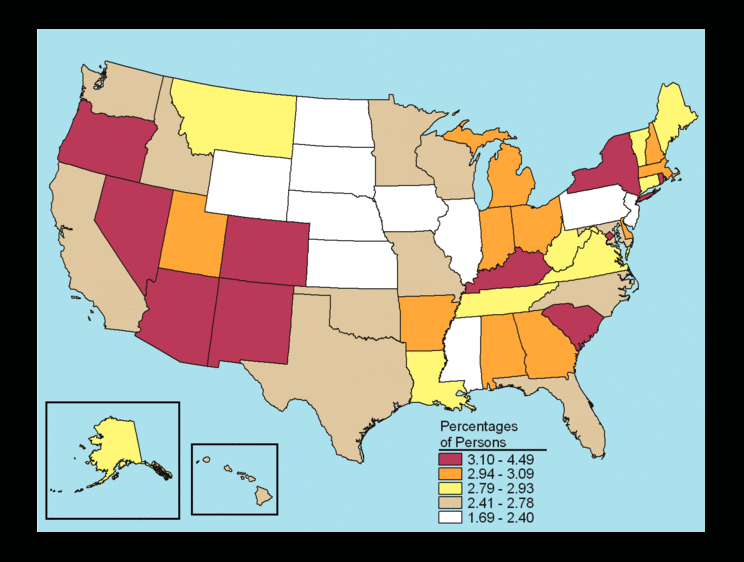
Percent of Population Engaged in Illicit Drug Abuse, by state, 2006- 2008
Past year alcohol use disorders nationally ranged from 4.8 percent in a substate region in southern Pennsylvania to 14.6 percent in a region in the District of Columbia. New Jersey also enjoys a relatively low rate of alcohol dependence, at 6.51%, consistent with a trend that extends through much of the eastern seaboard. Still, New Jersey’s rate of binge alcohol abuse (defined as consuming more than 5 drinks on one occasion on at least one day in the past 30 days) remains disturbingly high at 22.87%, and the number jumps to 43.52% for residents between the ages of 18 and 25. In fact, nearly 30% of New Jersey’s kids aged 12 – 20 reported alcohol use in the past month, suggesting that the state could do more to keep alcohol out of the hands of underage residents.
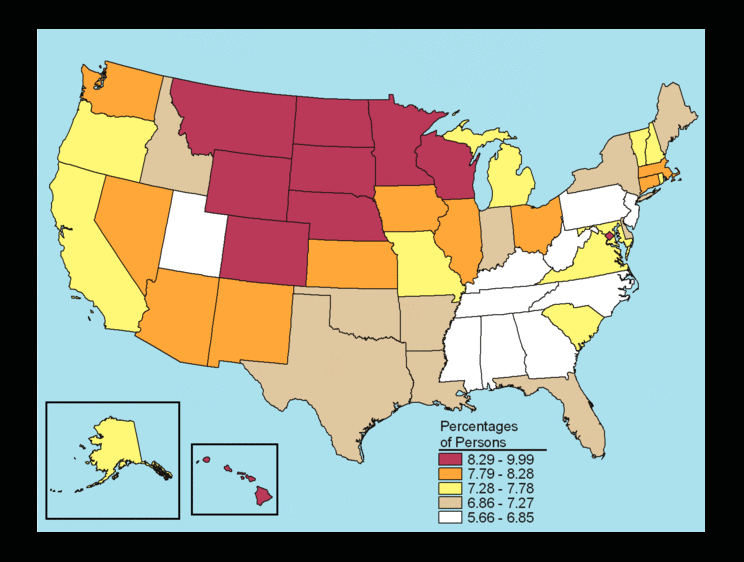
Percent of Population Engaged in Alcohol Abuse by State, 2006-2008
Unfortunately, the surveys do not offer guidance as to why some states have higher rates of substance abuse, so we cannot speculate about the impact of the economy, poverty, or regional cultural values on these numbers. They do show, however, that abuse rates are not uniform, and that they are capable of change and of reduction.
Complete information on the National Survey on Drug Use and Health can be found at http://oas.samhsa.gov/nsduh.htm.
Nancy Delogu is an attorney specializing in employment law with Littler Mendelson, P.C. in Washington, D.C.
|
Did you know? |
|
On July 8, 2011, the Drug Enforcement Administration published in the Federal Register a letter denying a petition to initiate rulemaking proceedings to reschedule marijuana from a Schedule I substance (i.e., a drug with no recognized medical application and a significant likelihood of abuse) to a Schedule III or IV substance (which include most commonly prescribed medications) pursuant to the Controlled Substances Act. The petition asserted that cannabis has an accepted medical use in the United States; that it is safe for use under medical supervision; and that it has an abuse potential that is lower than that of other drugs. In support of its decision rejecting the petition, the DEA attached a detailed scientific and medical analysis provided by the Department of Health and Human Services. The bottom line? The federal government is not going to accept the use of “medical marijuana” now or in the immediate future. You can find the document in Federal Register Volume 76, No. 131 (page 40551) (July 8, 2011). |